
Built on Shaky Ground: How Canada’s Housing Policies are Hurting Economic Growth
Canada’s housing policies are driving an affordability crisis and holding back economic growth. Here’s how development fees, slow approvals and restrictive zoning got us here, and how we get out.
Opinion
The figures in this article are as of April 2025.
Canada’s economy has a housing habit. Real estate is where most Canadians live and keep their savings, and it has also become the engine of our national economy. Home prices have risen much faster than incomes, and new construction hasn’t kept up with population growth. Meanwhile, productivity and innovation have stalled.
Those two things are connected. When so much of our wealth and effort goes into bidding up the price of houses, there’s less left for the industries and ideas that build long-term prosperity. The cause isn’t greedy realtors or developers. It’s government policy: high development fees, slow approvals and restrictive zoning have choked the supply of housing. The result is an affordability crisis and an economy that leans on ever-rising home values, while other industries go short of the capital and talent they need to grow.
An economy built on real estate
Real estate has overtaken every other sector to become Canada’s largest industry by GDP. In the latest yearly figures, real estate and rental leasing produced about $303 billion of output, well ahead of manufacturing ($203 billion) and oil and gas ($118 billion). Add the financial services tied to it, mortgages above all, and construction, and real estate makes up about 28% of the whole economy. More than one dollar in every four of Canada’s GDP now comes from housing, property sales and the loans behind them. That’s far above our historical norm and above many of our peers.
You can see it in any growing suburb or downtown: cranes, trades and realtors all making a living from property. In 2023 the construction industry employed about 1.58 million people, nearly 8% of all jobs in Canada, before you count real estate agents, mortgage brokers and property managers. Owning a home is a social expectation and a financial plan at the same time, a bet that rising values will secure your future. For many Canadians, their home is the only investment they have.
What happens when a country stakes its growth on building and selling houses to itself? GDP looks healthy in the short run while the industries that drive long-term prosperity are starved. Those industries are also less exposed to interest rates and matter more for competing globally. At the height of the boom, Canada put roughly twice the share of its GDP into housing that the United States did, and about 3 percentage points more than Australia, a country known for its own property obsession. Housing was by far the biggest destination for Canadian investment in the 2010s. Investment in machinery, equipment and technology, the things that raise productivity, fell behind. Canada spends only about 5% of GDP on business investment outside housing, roughly half the US rate. We’re putting our money into houses instead of factories, labs and startups.
What an overheated housing market costs us
Every dollar that goes into an overpriced home is a dollar that isn’t starting a business or improving how we make things. Investor Martin Pelletier put it bluntly: “The problem with real estate is that it’s a non-producing asset… once it goes into real estate, that money’s gone.”
Paying more for a house doesn’t make it produce more. When a Toronto bungalow goes from $500,000 to $1 million in five years, it’s the same house with twice the debt attached. “There’s no continual compounding economic spinoff from that investment,” Pelletier says. A dollar put into a new software company or a modern piece of machinery can create income, exports and jobs for years.
The numbers back this up. Canadians have recently been spending as much on home renovations and real estate transaction costs as the country invests in all machinery, equipment and intellectual property combined. We put as much money into countertops, hardwood floors and agent fees as we do into our ability to produce. Trevin Stratton, an economic advisor at Deloitte, has described business investment in Canada as “flagging”, and our productivity growth trails other countries as a result. Canadian companies struggle to compete globally when they underinvest in technology.
Expensive housing also costs us talent. If young people can’t afford to live in the cities where the opportunities are, or if rent and mortgage payments take everything they earn, fewer of them start companies or move for better jobs. Why risk a new venture if it means giving up on ever owning a home? Why move to Toronto or Vancouver for a great job if you’ll never afford to buy there, or even find a reasonable rental? Royal Bank CEO Dave McKay has warned that if we don’t solve affordability, “it’s too expensive to live here, we don’t attract the talent, we don’t retain the next generation”. I know talented people in tech who are thinking about leaving Canada for the US for exactly this reason.
That kind of economic migration is a serious problem. As skilled workers look for cheaper places to live, we risk losing doctors, engineers and other people our communities depend on, along with tech workers. Canada has one of the most educated populations in the world. As housing gets less affordable, we risk losing the people who make that true.
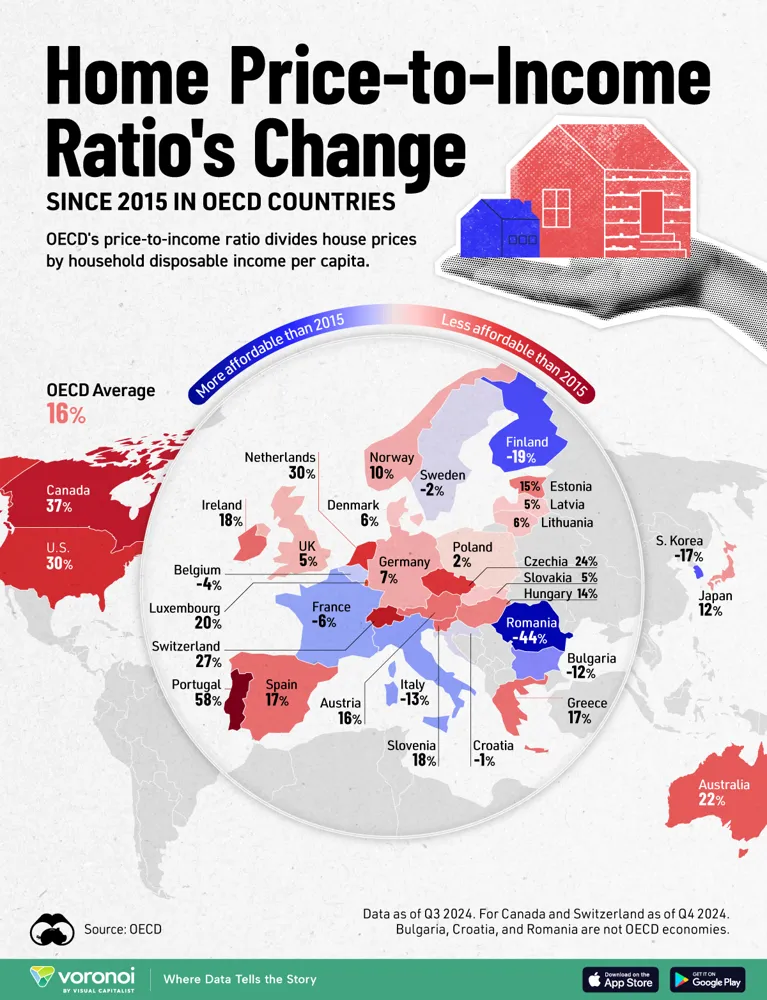
Since 2015, Canadian home prices have climbed much faster than incomes, with the house price to income ratio up 37%. That’s ahead of most OECD countries. Germany rose 7% and Japan 12%, and some countries became more affordable. Source: Visual Capitalist
Fees, red tape and restrictive zoning
So how did we get here? It’s easy to blame speculators or developers, but they’re responding to the incentives and limits that policy sets. Most of the blame belongs to government rules and red tape that have choked the supply of housing and pushed prices up, sometimes by accident and sometimes on purpose. For years, cities have piled on development charges, strict zoning and long approval processes. Together they work like a heavy tax on new homes. We build more slowly, and each home costs a lot more.
Development charges
Development charges are the fees cities charge builders to pay for new roads, sewers and other infrastructure. “Growth pays for growth” sounds fair. In practice, these charges have exploded in many Canadian cities and added a large premium to every new home.
Take Ontario. An analysis of 27 municipalities found that every one of them raised development fees far faster than inflation between 2004 and 2024, a period when inflation totalled 54%. Some raised them by as much as 800%. Government charges, including development fees, levies and taxes, now make up about 31% of the price of a new home in Ontario on average. In the Greater Toronto Area, development charges alone can add up to $184,000 to an average new house.
Cities short on money push more of the cost of infrastructure onto new home buyers. That makes the homes unaffordable for many people, so some never get built. Nobody gets housed, and the city doesn’t collect the new property taxes either. Compare Calgary, where a similar new home faces about $22,000 in development fees, a fraction of Toronto’s. It’s no coincidence that housing tends to be more affordable where these costs are lower.
Zoning
For decades, Canada’s fastest-growing cities reserved most residential land for detached houses. That effectively banned townhouses, duplexes and apartments across huge parts of our cities. Until recently, most of Toronto’s residential land allowed nothing but detached houses, an area nicknamed the “yellowbelt” where growth was frozen. Vancouver had zoned roughly 70 to 80% of its residential neighbourhoods for single-family homes, though recent reforms have started to change that. Many suburbs still fight hard against denser projects.
The goal was to protect the character of neighbourhoods. The effect was to cap the supply of homes where demand is highest. With most city land closed to new density, building was pushed out to distant suburbs or squeezed into a few high-density areas, and neither has kept up with need. The RSM Canada economics team put it this way: “lengthy approval times and restrictive zoning laws… put a hammerlock on development.” We designed our cities so it’s very hard to add housing, and now we’re living with the result.
Approvals
Even when a developer assembles land and proposes homes that fit the zoning, they face some of the slowest approvals in the developed world. Rezoning hearings, environmental assessments and building permits all take time. In Ontario, an average residential project takes about 25.5 months, or roughly 775 days, to get its permits and approvals. One global index of how easy it is to build ranked Canada 34th of 35 OECD countries for permit speed, ahead of only Slovakia. That’s an embarrassing result for a G7 country.
Every delay adds cost. Architects and engineers stay on retainer, interest builds up on the land, and crews sit idle. One study found that approval delays can add 8% to 14% a year to total construction costs. In the end, those costs are passed on to the buyer or the renter.
Change has been too small
Governments haven’t ignored the problem, but most of what they’ve done is small next to the size of the crisis. Ontario’s housing plan promises to “streamline planning regulations and approvals processes” and requires cities to set minimum housing targets. The federal government launched a $4 billion Housing Accelerator Fund to reward cities that speed up approvals and update their zoning. Ottawa also removed the 5% GST on new purpose-built rentals to encourage more apartment construction. These are good steps, but they only adjust a system that’s under deep strain. As long as cities rely on development fees to pay for infrastructure and keep restrictive zoning in place, new housing will stay scarce and expensive.
Affordable housing helps the industry too
Many people assume that lower home prices would hurt the real estate industry and the wider economy. If houses cost less, builders, agents and lenders would earn less. A speculator flipping a house might prefer prices to keep climbing. But the housing sector depends on volume and stability over the long run. A market where homes sell at a sensible multiple of income has more sales, more new building and more activity around it than one where most buyers are priced out.
We’re seeing that now. A decade of fast price growth, followed by higher interest rates, has brought new development to a halt. When only a small share of families can afford a home, sales stall. When fees and land costs make projects stop adding up, construction slows. In the Greater Toronto Area, new condo sales in 2023 were 81% below their 10 year average, according to industry data. Developers have shelved or delayed projects despite the shortage, because they don’t expect units to sell at prices that cover their costs. The number of cranes over Toronto has dropped by more than 20%, and each crane means work for dozens of tradespeople.
The slowdown reaches everyone. Realtors earn commissions only when homes sell. Many individual landlords have low rental yields, and some are losing money every month. Construction workers face uncertain work as housing starts drop. Furniture and appliance stores feel it too, because people who aren’t moving aren’t furnishing new homes. The whole housing economy depends on homes changing hands.
For years, Canada’s real estate sector boomed on rising prices. If homes become too expensive, the industry runs out of customers. A stable, accessible housing market would give up the quick gains of speculation in exchange for steady business for decades. The sooner governments and the industry see that their interests line up, the sooner we can escape this high price, low volume trap.
How we rebalance
Rebalancing Canada’s housing market and economy won’t be easy, but it’s necessary and it can be done. We already know most of the answers. What’s missing is the political will to carry them out together. Here’s where to start.
Build more homes, faster
Canada needs a building effort on the scale of post-war reconstruction. CMHC has estimated that we need millions of additional homes by 2030 to restore affordability. Getting there means speeding up every step of development. City approvals should take months, not years. Provinces could set deadlines, so a project that meets every requirement is approved automatically if the city hasn’t decided within, say, 12 months. Permitting software can speed things up, and consultations shouldn’t give a small group a veto over homes that benefit everyone else.
Rewrite zoning and free up land
Zoning that allows only detached houses has to go. Minneapolis and New Zealand have already allowed duplexes and triplexes in neighbourhoods that used to permit only single-family homes, and those neighbourhoods are doing fine. Canadian provinces and cities should allow more homes everywhere, especially near transit and jobs. That doesn’t mean 50-storey towers on every street. It means gentle density, such as townhouses, low-rise apartments, secondary suites and multiplexes, built into existing neighbourhoods.
We should also use land we’re wasting. Old commercial and industrial sites, and even surplus parking lots, can become housing. The federal government owns a lot of land in our cities, and its surplus land could be opened up for affordable homes.
Pay for growth differently
We need new ways to pay for infrastructure that don’t punish people buying new homes. If the cost of every park, pipe and road keeps landing on the price of new houses, we’ll never fix affordability. Spreading those costs across the wider tax base makes sense, since the whole community benefits from growth.
Build more productively
Building more housing also takes people and better methods. Canada is short of skilled trades, so we need more training. Modular and prefabricated building can speed up construction and lower costs if it’s used at scale.
Keep speculation in check
We should be careful with policies that pump up housing demand. Where governments act on demand, they should focus on the speculative buying that distorts the market.
Back innovation
Canada’s economic future depends on valuing efficiency, new ideas and smart risk. The US has the deepest pool of risk capital in the world, and Canada lags in both investment and the adoption of new technology. Too often, businesses and consumers stick with old ways of working because they’re familiar, even when better ones exist. That slows growth and leaves our industries less competitive. Governments should encourage private investment in innovation, remove barriers that hold startups back and push industries to modernize.
That includes property management. If you’re a property manager, Tuze (tuzeos.com) is the Canadian company I started to help teams like yours get more done with modern software and AI.
Housing could become boring again
The point of all this is to rebalance our economy, away from depending on rising home values and toward real productivity and opportunity. A home should be a foundation, a roof that lets us get on with the rest of our lives, rather than the main measure of economic success. If we rein in development charges and red tape, housing could become boring again. That would be a good thing. A stable, affordable market would free governments and Canadians to focus on developing talent, supporting new businesses and investing in technology and green infrastructure, which create wealth instead of moving it around.
Canada has a choice. We can keep the status quo, where housing stays unaffordable and growth limps along on debt and frustrated hopes. Or we can build a future with plenty of housing, where prices and rents come back to reasonable levels and the economy is free to grow in other directions. The second path means undoing years of bad policy and standing up to the people who profit from scarcity. Our leaders will need the courage to tell younger Canadians that they aren’t doomed to live in their parents’ basements, and then follow through. We’ll also need to treat housing as essential economic infrastructure, as we do roads, bridges and telecommunications.
The reward would be enormous. A young family in 2030 could afford a home without winning the lottery. Businesses could attract talent from around the world because people know they can find a decent place to live. Banks would lend more to businesses and less to oversized mortgages. And the real estate industry would do well by building and selling a large number of good homes, instead of chasing a few wildly expensive deals.
We have the tools and the knowledge to do this. What we need now is the will. Canada’s housing policies have been part of the problem for a long time, and they can become part of the solution. By cutting excessive fees, speeding up approvals and welcoming growth, we can bring housing back to earth and let the rest of the economy reach its potential. That wouldn’t weaken the real estate sector. It would save it from itself and give young Canadians a better future.